May 1, 2026 MASS Meeting
This was our 92nd meeting. and we had a good turn out with Keith, Hank, Don, Harry and myself. There was a full moon rising as we started the meeting and May will be one of those unusual months with 2 full moons. The second will be a “blue” moon.
Just so that this link doesn’t get lost in the voluminous notes, I wanted to put the outreach to Planetary Society’s Advocacy Outreach Center at the beginning. Please, if you disagree with the White House’s cut of 23% of the NASA budget and 46% of NASA’s science with the potential loss of 50 science missions, contact your Congressional representatives to express you displeasure. A few simple clicks, an email address and a physical address and name, will contact your two Senators and Representative with a canned email. If you wish to edit your outreach, that can be easily done too. Here is the link.
May 1, 2026 MASS Meeting
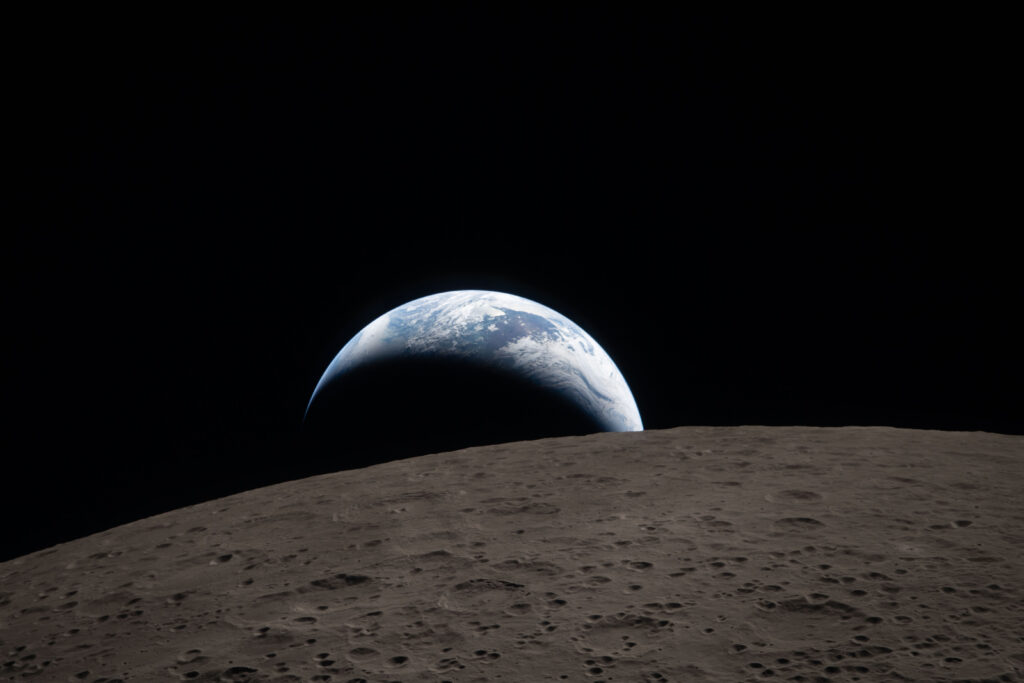
Voted the favorite picture from Artemis 2, Earthset behind the moon
Misc
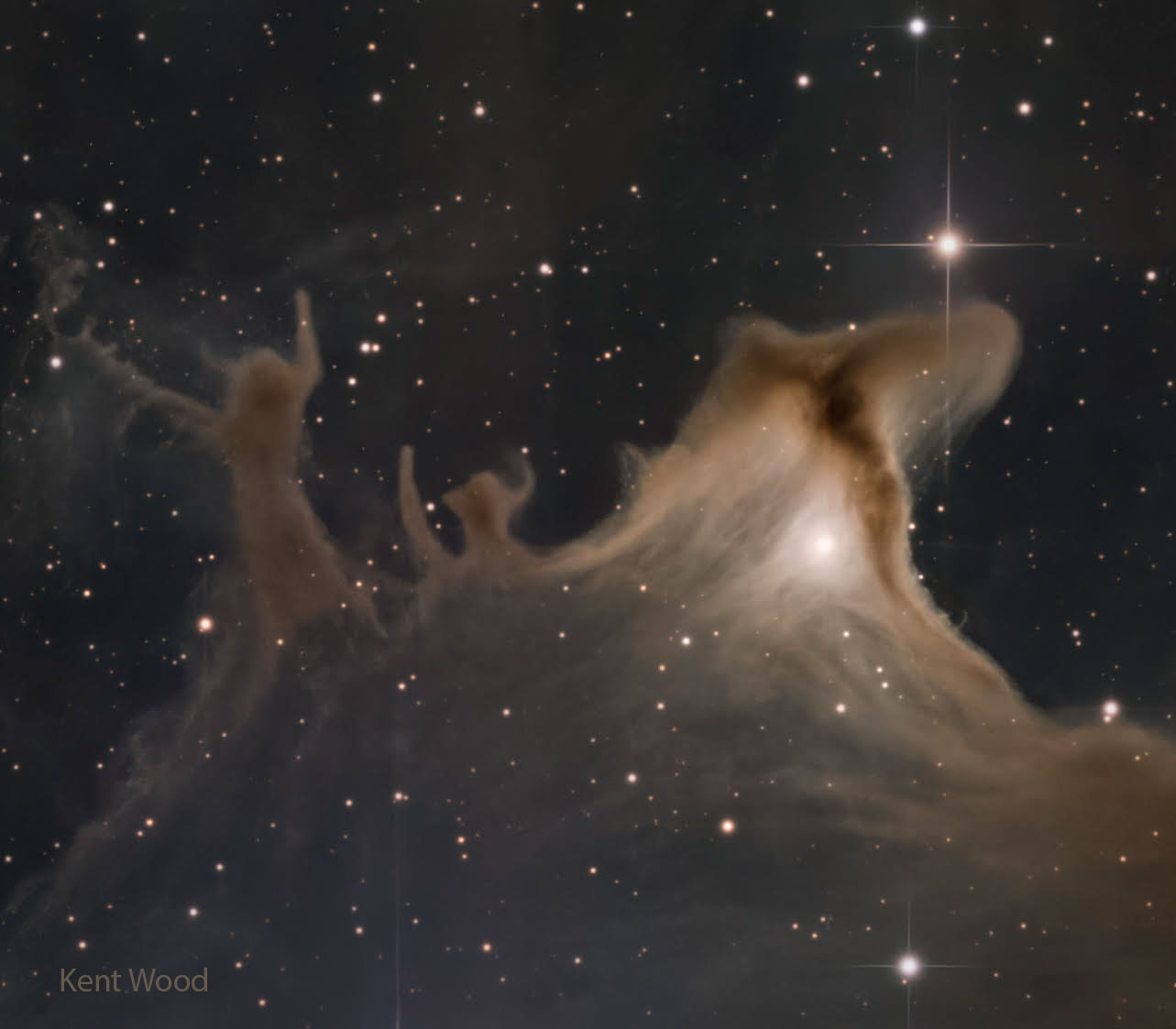
Astronomy Day at Harper College was the Saturday before the meeting. I got to see Harry, Keith, Dean, Beth and Chad at the event. Kevin Cole, geologist and astronomer professor at Harper, did a nice presentation about Artemis and NASA’s Commercial Lunar Payload Services (CLPS). The CLPS program was successful on its third try of landing on the moon when the Blue Ghost craft from the Firefly company landed in Mare Crisium (that Mare is located at the end of the poodle’s tail). Their next try is for the far side of the moon in 2026 and the Gruithuisen Domes, with its odd rocks, in 2028 and then again in 2028 at the South Pole. The next talk was about the 10 best pictures of 2025 from the APOD NASA web site and finally Beth and Chad spoke about “Stories of Space”. Below is one of the best APOD pictures according to Dale Dellutri. Don’t tell me you don’t see someone with outstretched hands and a smaller figure to the right doing the same motion. Dale said that is called apophenia, where we find order in random data. Seeing the face on Mars was the same effect and Victor Glover, Artemis 2 astronaut when observing the terminator of the moon, said he saw what looked like dinosaur tracks among the shadowed craters. Cool!!
On 12/20/25, Beth and her “Stories of Space” was mentioned on the “This Week in Space” podcast, which is one of my favorite weekly podcasts with Rod Pyle, editor of the NSS magazine, Ad Astra, and Tarik Malik, managing editor of Space.Com. Here is a link to the latest of Beth’s efforts with Maritime Launch Services on 11/20/25 from Nova Scotia on the Barracuda hypersonic test platform sub-orbital launch. The rocket can ultimately send 40 kg to heights of 120 km.
I also attended the CSSS meeting last December at Schaumburg Library. The featured speaker was Larry Boyle who presented his “2025 in Space” via Zoom. He said 72 countries have a space program, the US Space Force has a $40 billion budget compared to NASA’s $24 billion and the Golden Dome Space Defense project is expected to cost $175 billion, China is the second largest space program and the European Space Agency (ESA), which is a consortium of 23 member states, is third.
On 2/28/26, Harry and I went to a COD talk titled “The Story of the Solar System” by astronomer Joe DalSanto. You can watch it on the COD channel of YouTube.
I went on 3/22/26 to see the movie “Project Hail Mary” with Carol and two of my grandkids, Ryan and Megan. I was excited to see the movie after reading the book in July 2021. This was Andy Weir’s third book and the second to be made into a movie. He also wrote “The Martian” as his first book. I was surprised that I was the only one at the meeting who had seen it. I gave it a great review. I enjoyed the story of an alien encounter so much that I reread the book in March. His second book, “Artemis”, is the only book of his 3 not to be made into a movie
Next I shared with the group a couple of jokes from “This Week in Space” podcast. What did the hummingbird say to the alien? (pause) Take me to your feeder. The next one, When I was in school I thought my teacher thought I was going to be an astronaut, (pause), because she told me I was only taking up space.
I then took a poll of the group, Who believes that there is alien life? What form is it bacterial, multi-cellular, intelligent, communicating? Have they visited earth? Are they currently here? The response was that all 5 of us believe there is alien life somewhere in the universe. Only 2 of us (Keith and I) think it is intelligent and communicating. No one in the group believes they have visited here or that UFOs are aliens. Polls by YouGov and Pew research center say 65% of Americans believe in intelligent life on other planets, 40% believe UFOs are alien spacecraft, younger Americans and men more likely to believe in alien life, internationally up to 20% believe aliens have visited earth, Durham university found 87% of astrobiologists agree that extraterrestrial life exists. A 2024 survey said 37% of people believe aliens are currently living among us. Keith suggested that we watch his video about the Drake Equation that tries to estimate the number of communicating alien civilizations in the Milky Way Galaxy. Which we did on the YouTube MASS channel. One of the factors has really increased the chance of alien life since I was a kid, is the probability that exoplanets exist, astronomers now think each star in the Milky Way has a least one planet and over 6000 of them have been discovered. But other parameters might have decreased, like the longevity of civilizations, now that we have had a recent pandemic, artificial Intelligence if it controls our nuclear deterrence systems, is more likely than humans to push the launch button and there seems to be a large asteroid on a potential earth collision announced every few months. Mankind doesn’t seem to be responding to these threats in any coordinated manner.
Artemis 2 Mission
Artemis 1 rocket spent 3 months on the pad before it finally launched in November 2022.
Artemis 2 had a similar slow start, on 2/2/26 during the Wet-Dress-Rehearsal (WDR), there were hydrogen leaks and Orion capsule hatch problems. The WDR was tried again on 2/17 to 2/19/26 and the rocket was successfully tanked with propellants but issues with the helium flow on the second stage would require a roll back to the Vertical Assembly Building (VAB). I joked that I hope we don’t have to go thru the entire periodic table of elements to get the rocket off the ground. For those of you not familiar with the periodic table of elements, hydrogen and helium being the lightest two elements they are the first two elements at the top of the table.
On 3/13/26 NASA said the Artemis 2 rocket would again roll out of VAB on March 19 and that they aim for a planned launch on April 1. They were not going to do a wet dress rehearsal because tanking the rocket reduces the life-time of the tanks. I was surprised to see the Alabama manager, John Hunnicutt, of SLS rocket ground support, use the word, “shit”, during the NASA press conference about the launch issues. He also said the risk for failure of the Artemis 2 mission was somewhere between 1 in 2 and 1 in 50 for mission success. That statistic perked up reporter’s ears so much that it was all they could ask about during the remainder of the press conference.
Everyone was surprised, including Dean, Keith and myself, that the Artemis 2 launch was extremely smooth. There was only a 10 minute delay in the countdown and no hydrogen leaks.
Artemis 2 launched on April’s Fool’s Day, a Wednesday evening, at 5:35 PM. It has been a long 19,096 days from the Apollo 17 splashdown and Artemis 2 launching. Dean and Keith messaged each other during the event and Phil had a relative down in Florida that recorded the launch. The video (watch only to the 5:40 mark) from GreatSpaceX had a good summary of the early days of flight. There was a brief communication loss while the crew was in Earth orbit and Christina Koch had to fix the toilet. But they performed their Trans Lunar Injection burn (TLI) on Thursday, April 2. The video has a good picture to show the size of the Orion capsule and command module compared to the Blue Moon lunar lander from Blue Origin and the Starship lunar lander from SpaceX.
NASA Moon Joy, shows “Rise” zero-gravity stuffed toy. Happyness is the toilet working.
I’m probably spending too much time discussing the toilet issues, but it was an up and down problem during the mission. Toilet is a “no-go” video. Collapsible Contingency Urinals (CCUs) are long plastic tubes that astronauts use when the toilet is not working.
Now was time for the encounter with the moon. SpaceflightNow 16 minute video has Jim Lovell message recorded before he died last August. The four Artemis 2 astronauts are between age 47 and 51. Meanwhile the 5 Apollo astronauts that are still alive, Buzz Aldrin (Apollo 11), Fred Haise (only orbited on Apollo 13), Dave Scott (apollo 15), Charles Duke (Apollo 16) and Harrison Schmitt (Apollo 17), all are in their 90’s. Apollo astronauts that orbited in the command module were the loneliest people ever, they were at times thousands of miles from the nearest human. The video shows the mission patch from Apollo 8. It shows the location of the newly named craters, Intrepid and Carroll. The name Carroll was suggested for Reid Wiseman’s wife, Carroll, who died in 2020 and the other for the Intrepid Orion capsule which was being reused from Artemis 1. Reid is raising 2 daughters as a single parent. There was a message of “love” from Victor Glover for Easter. It was similar to the reading from Genesis during the Apollo 8 mission which occurred during Christmas. Then the astronauts got to view a solar eclipse and the sighting of 6 impact flashes on the dark part of the moon. These were more than what was expected and reinforces the danger on the moon’s surface from meteor impacts. The Apollo 17 crew said they saw 3 lunar impacts in 1972. Since then, over 400 impacts have been confirmed on the moon from earth based observation. Artemis 2 crew of Reid Wiseman, Victor Glover, Christina Koch and Canadian astronaut, Jeremy Hansen, was announced on April 3, 2023. They were a unit for over 3 years. The Artemis 3 crew which is scheduled for late 2027 is still not announced. Earth set was the favorite picture of the mission. They were out of contact with earth for 40 minutes during their swing around the moon.
Marcus House had a nice summary of the entire Artemis 2 mission. His video (watch from beginning to 24:15 mark and skip the razor commercial), includes playing with water spheres, the Orion capsule has 30% more inside volume than Apollo and how they can stow the seats to give them additional space, the command module is made by ESA, discussion of toilet issues and a laser communication test. The video goes on to show the start of eclipse with 6 impact flashes, a call to the ISS astronauts, the entry path Orion will take thru the atmosphere, the separation of Orion and service module, deployment of the parachutes and finally exit from capsule. The Avatar chips that will help measure the effect of radiation on the astronauts cells is also mentioned.
On 4/10/26, I watched it splashdown at 7:07 PM with Keith & Dean. There were 40 people on 6 boats in the recovery effort. It took the full 2 hour estimation to extract astronauts. It took 50 minutes to open the hatch. Then 4 people climbed into the capsule. One hour and 15 minutes after splashing down the floatation collar was finally attached. At 8:25 PM the “front porch” was attached to the capsule and 6 minutes later the first astronaut came out. I was amazed that when the 4 astronauts were in the front porch, they separated from the capsule. It seemed like they were drifting in the Pacific Ocean in a kiddie pool. This was done so that the helicopters could pick them up. This seemed the most dangerous part of the mission when they were plucked out of the kiddie pool on a line dropped from the helicopter. The wash from the helicopter rotor seemed like a hurricane. Two astronauts were cranked up to each of two helicopters and then landed on the boat so they could walk to the medical area. Compared to SpaceX’s recovery of the Dragon capsule it seemed overkill. For Dragon, the astronauts stay in the capsule until it is lifted on the boat. The Dragon astronauts are coming back after over 6 months in space and need a wheelchair after exiting the capsule. I’m not sure how longer stay Artemis astronauts will do sitting on a pitching kiddie pool raft in the ocean. There was a lot of coverage in the news media of the Artemis 2 mission. The astronauts were very engaging with the public. SNL even had a skit about them, which showed the interest in the mission. I asked the group if they think the American public will stop taking an interest after the third or fourth Artemis mission like they did with Apollo. The group thinks Artemis will have more staying power. But I’m not so sure, after the novelty of each mission gets less and less. NASA says they will fly about two manned missions a year to the moon base that is to be built out to the mid-2030s.
Dr. Becky video does a great job showing the dynamics of the Artemis 2 flight path to the moon (watch starting at 7:10 – stop at 15:10 mark). She lists the distance records for Artemis 2. They went 4067 mi beyond moon and set a distance record from earth of 252,756 mi (4101 mi farther than Apollo 13). There is an explanation of the images from the mission. She also estimates that the running cost for Artemis is so far $93 billion. From her perspective, we could have gotten the same amount of science for a much lower cost with a robotic mission. But robots don’t inspire the same amount of interest as people in space do.
Planetary Society best images from Artemis 2. Not to be too picky, but in the 5th photo on the site, the brown part of earth is Africa, not Australia. The confusion stems from north being at the bottom of the image. Dr. Becky did a good job explaining that picture in the previous video. There also is the picture that shows a discoloration of the Orion heat shield. Dean noticed this and was worried that chunks might have fallen away during reentry like on Artemis 1. NASA has stated that the heat shield performed well and there was no issues.
Astronomy.com had a great set of pictures including, Mare Oriental, earthset behind the moon, astronauts in eclipse glasses and the solar eclipse with planets to lower right.
Radiation testing with Avatar on Artemis 2. There is a biology experiment called Avatar which has artificial organs, about the size of a thumb-drive, made from cells taken from a blood draw of the astronauts. The fact that each of the 4 Avatar chips have cells from a single astronaut will allow scientists to determine how well each astronaut will respond to radiation outside the Van Allen Belts. This technology will also allow people to have their cells tested to see how they individually will respond to various chemo-therapies for cancer. There is a big difference on how people respond to the difference chemicals and doctors would like to know which ones work best for their patient.
Radiation in space – ISS astronauts get 300 mSieverts/yr of exposure. The US occupational max is 50 mS/yr. For an astronaut lifetime the allowable dose is 600-1000 mS. A sensor on Mars rover mission detected .66 sievert on its 253 day (~8 month) trip to the planet. 1 sievert dose gives a person 5.5% more of an increase of getting cancer.
Picture of the astronauts at White House. The astronauts didn’t say a word during the 22 minute event. Who has 4 astronauts in his office and never speaks to them? Trump only commented on the size of Jared Issacman’s ears. None of the reporters asked about Trump’s 23% cut to the NASA budget. In other testimony before Congress, Jared Issacman, while addressing the Kansas Senator, said Pluto should be reconsidered a planet. Clyde Tombaugh who discovered Pluto was from Kansas.
Will public interest in Artemis continue when the mission is just an earth orbiting event like Artemis 3? Will the HLS landers be available? Will Blue Origin (BO) beat SpaceX in producing a human lunar lander? BO is launching their MK 1 version of the lander soon. SpaceX still has to get their Starship orbital. HLS landers will be autonomous because they have to perform an unmanned test landing on the moon before NASA would be comfortable put people on them. An Apollo 10 mission is not needed during the Artemis program because of this autonomous capability. When will be get the detail for Artemis 3 mission? Its crew? And the design of the HLS landers? There was talk about a 1.5 version of Blue Moon lander and some have speculated that SpaceX might land its Starship lander on its side on the moon. The number of refueling missions for the two landers while in earth orbit is also being debated. There are a lot of questions and only about a year and a quarter to get the answers.
Artemis Program
A week before Artemis 2 launched, NASA and Jared Issacman rolled out a new lunar plan on March 24 in an event titled, “Ignition”. Just between 2027 and 2028, the end of Trump’s second term, there will be 20 robotic landers and 2 human landings. Also, there will be an interplanetary space nuclear reactor going to Mars in 2028. The International Gateway around the moon is paused (NASA has already spent $4.5 billion on it) and NASA will focus instead on a surface moon base.
The Near Rectilinear Halo Orbit is gone as a requirement now that Gateway is no longer planned. Apparently the 2 delivered modules from Europe have corrosion problems. They might be repurposed for surface habitats and the Power & Propulsion unit will be incorporated into the SR-1 Freedom nuclear Mars mission which will demonstrate fission power propulsion. It will release “Skyfall”, a group of 3 Ingenuity-class helicopters, to the surface of Mars.
The nuclear reactor in space will be followed by one on the surface of the moon in 2030. I’m sure this is part of the lunar land grab tactic by the US in response to our worries that China might do if they get there first. Nothing like saying “don’t land here” by putting a reactor there.
NASA is also sending 30 robotic landers, 10 per year in 2027, 2028 and 2029, to establish communication networks and other lunar infrastructure. This is part of CLPS, NASA so far has launched 4 missions, only Firefly’s Blue Ghost 1, was a total success, 2 others toppled over limiting their missions and the other didn’t even get out of earth orbit. Each phase of the lunar base will cost $10 billion. $20 billion would be spent over the next 7 years (Phase 1 and 2).
This is the same administration that is cutting NASA by 23% but they claim over $10 billion will come from the Big Beautiful Bill, but that just seems a way to get around having Congressional controlled funding.
Because the ISS is being de-orbited around 2030, NASA is encouraging the development of Commercial Space Stations so that the Chinese are not the only ones in Low Earth Orbit. The new plan is to put a new module on the ISS which would help companies like Axiom develop their plans. The only problem is NASA doesn’t have enough money for either the old or new approach to shift the US from the ISS to a commercial space station.
Issacman is also trying to rebuild the NASA workforce which is currently 25% civil servants and 75% contractors. Part of this issue is from the departure of 20% of NASA’s workforce due to the DOGE effort to reduce government size during the turmoil of 2025-2026.
I think Issacman is a good guy he said he is for a program beyond “flags and footprints” on the return to the moon but he can’t buck the administration cutting of the budget or he’d be fired.
Other key points are, the SLS design will be standardized with the addition of the Centaur V upper stage. This will replace the current plan of using ICPS and then the future EUS (Exploration Upper Stage) which is $4 billion over budget. The second mobile launch platform, which was a billion dollars over budget, will be abandoned. It would have been needed for the taller SLS version with the EUS upper stage.
At the “Ignition” event, Artemis 3 was repurposed into an earth orbit mission that will dock with one or both HLS craft from SpaceX and Blue Origin and demonstrate use of the new spacesuits from Axiom. The launch was planned for mid-2027. Then just 2 months later, Issacman in testimony in front of Congress on the 2027 NASA budget, stated that Artemis 3 will be late 2027. That’s a 6 month slip in just 2 months of time. The accelerated assembly of the SLS for Artemis 3 might also cause problems. Much of the trouble of hydrogen leaks during the Artemis 2 countdown was due to the rocket sitting for too long. If Artemis 3 is now 6 months later maybe you don’t want to mate all those rocket pieces too early.
The use of HLS systems for Artemis was opened to whichever company is ready. SpaceX was to get the first 2 landings and then Blue Origin the one after that. Now, it will be whoever is ready first. The two companies are scaling back their original designs to try to address NASA’s new accelerated program. The question of the number of refueling launches to send their HLS spacecraft to the moon is up in the air. But they are still required to demonstrate an unmanned landing on the moon.
Artemis 4 and 5 are both landings on the moon and are scheduled for 2028. The listed Artemis 4 mission will be 7 days on the moon’s south pole with 2 astronauts. It will be a total 21 day mission and have up to 4 EVAs on the moon.
The earlier delays in the Artemis program was to due NASA trying satisfy everyone. This will not be a “flags & footprint” effort but a full effort to develop the moon for science and commercial efforts with at least a moon landing per year, maybe two.
The Moon base will be done in 3 phases. Phase 1 – will cost $10 billion and span from now to 2028. It includes, landers in 2026 – 2, in 2027 – 9, in 2028 – 10. For a total of 4 mt landed payload. The VIPER lunar rover lands on second Blue Origin MK1 lander in 2027. Phase 2 – costs another $10 billion and spans 2029 to 2032. It includes, landers in 2029 – 5, in 2030 – 6, in 2031 – 7, in 2032 – 6. These landers will put a total of ~60 mt payload landed, including a pressurized rover with a 10 year life from JAXA, “moonfall” drones, a solar power station and RTG power too. Phase 3 – costs another $10 billion plus. It spans 2033 to 2036. It includes, landers in 2033 – 6, in 2034 – 7, in 2035 – 7, in 2036 – 8. For a total of ~150 mt payload, including 4 crew 28 day landings. There also is a nuclear electric propulsion launch in 2028 called Space Reactor (SR1) which will take a year to get to Mars with technology adapted from the Gateway PPE (Power and Propulsion Element) module and will deploy “SkyFall” a set of 3 helicopters.
Marcus House does a good summary. (start at the 12:05 mark, end at 22:52) He also discusses the commercial space station that is to take over for the ISS and the repurpose of PPE module for a nuclear powered SR-1 Freedom mission to send a bunch of helicopters to Mars.
Gateway is out but a moon base is in. GreatSpaceX had a good video (end at 8:30 mark) detailing corroded modules, Hab & Logistics and PPE reused for SR-1 nuclear propulsion to Mars mission. Artemis 4 and 5 will occur in 2028, the SLS will use Centaur 5 for an upper stage but not $4 billion over budget EUS.
Nice picture of the 3 lunar landers, Apollo LEM, Mark 2 Blue Moon and Starship. The SpaceflightNow article talks about the Inspector General assessment of moon lander risk. The Apollo LEM is compared to the 2 HLS landers. The 171 foot tall SpaceX landers must be refueled in low-Earth orbit by an estimated 10 to 20 Starship tanker flights. Blue Origin’s MK2 Blue Moon lander will also need refueling in orbit. The OIG estimated that the loss-of-crew odds are 1 in 30 overall. This is compared to the Apollo astronauts risk of a 1 in 10 crew loss and space shuttle crews flew with a 1 in 70 risk. The south pole of the moon has 20 degrees slopes and the 14 story tall commercial building equivalent of Starship is a great risk. NASA’s requirement is an 8 degree tilt. Blue Moon stands at 53 feet tall. The LEM was 7 times shorter than Starship and half the height of Blue Moon. Starship’s astronauts will have to ride an elevator but the Blue Moon ones can use stairs. The elevator exit on Starship will be 115 feet above the surface.
Great SpaceX video good summary of HLS and Starship development. NASA is accelerating the HLS programs and brought Blue Origin back into the running for Artemis 4. The original plan was use SpaceX for the first two landings (was Artemis 3 & 4, now Artemis 4 & 5) and then give Blue Origin a try on the third moon landing.
SpaceX V3 of Starship is much delayed. Still no announced date for launch 12, last Starship flight was October 13, 2025 which was successful with controlled ocean landings for both stages.
It seemed Blue Origin had the lead with the MK1 launch happening in a few months but then there was a problem with the New Glenn rocket second stage last week. SpaceX version 3 of Starship launch is being delayed time after time. We’ll have to see how it goes.
Neil DeGrasse Tyson video titled “Why go back to the Moon?” has a good summary of Apollo and now we’ll try to do a land grab at the south pole of the moon to beat China to the frozen-ice resources.
Do we really care if China lands first? The US plan seems to be a much more permanent presence on the moon. The Chinese effort is more on the level of the Apollo program. But the land grab for prime lunar terrain could reward the country getting there first, not the one that plans to do more in-depth activities. Is Starship going to do that for us? It has a lot of habitable volume and mass. China moon landing hardware similar in size to Apollo but they will have to perform 2 launches to earth orbit to send all the hardware toward the moon. The capsule named, Mengzhou or “Dream Boat”, can hold up to 7 people and will be used for flights to their space station also. The rocket is called Long March 10 and has 7 engines on its first stage. The lander is called, Lanyue or “Embracing the Moon”.
NOVA (start at 13:45 end at 39:30) about Artemis 2. I intended to watch only part of the show, but the entire program is pertinent. South pole of the moon is the new goal and now we are in a race beat China. 60% of shuttle launches were delayed by hydrogen issues and the the 2 Shuttle accidents are discussed. Starliner issues are compared to the heat shield problem with Orion. Eric Burger from Ars Technica is shown often. Good description of SLS and Orion. Apollo cost $280 billion in today’s dollars. NASA had 5% of GNP of the country, now NASA has only .5% of that. RS-25 engines cost $140 million each and there are 4 of then on the first stage of SLS and they are discarded with each SLS flight. SpaceX uses Raptor engines costing only $500,000 each. Ex NASA administator Bill Nelson brags the engines are being reused on SLS but doesn’t mention that they are now discarded.
The podcast “This Week in Space” had a pertinent episode that aired after our meeting but I included it here. They talked about the astronauts Oval Office visit and a commercial company wanting to visit the asteroid Apophis, whether Blue Moon will fly in May and which HLS lander might be ready for Artemis 3. The Apollo LEM had 4.5 cubic meters of internal space and stood 7 meters high. Blue Origin’s MK2 lander has an unknown internal volume and stands 16 meters high. Finally, SpaceX’s Starship lander has 614 cubic meters of habitable space and stands 52 meters high. They think Blue Origin might be in the lead because the early version of their lander, MK1, will launch to the moon in 2026.
NASA Budget
NASA got a new administrator with Jared Issacman on December 17, 2025. The Senate confirmed him with a vote of 67 to 30. Asked by Sen. Dan Sullivan (R-AK) about the President’s proposal to eliminate the Office of STEM Engagement (OSTEM) and reduce the funding to the NASA Research Opportunities in Space and Earth Sciences (ROSES) program, Isaacman said the following, “If confirmed, I can commit to being an advocate for science and a strong American workforce and will do all I can to maximize the scientific value of every dollar provided by Congress.”
NASA lost a lot with the confusion on the 2026 budget. From a Casey Drier podcast it was stated that NASA is still confused and lost 20% of its workforce, mostly tech people not administration persons. The “Humans to Mars” effort seems to have been diminished and been replaced with a new drum beat of beat China with a new manned moon landing. In November, Blue Origin (BO) and SpaceX submitted revised HLS (Human Landing System) designs and launch plans as a response to the accelerated moon program. SpaceX reduced their HLS craft size, just like Robert Zubin wanted them to do. We have to remember that BO has to do refueling of its Mark 2 lunar lander just like SpaceX has to with its Starship HLS craft. SpaceX’s HLS contract is for mid-2027 delivery. The GAO gives only 70% confidence of Artemis 3 flying in Feb 2028. SpaceX has been paid $2.7 billion of the $4.5 billion contract for HLS by completing 49 milestones but refueling hasn’t been done yet and Starship has not even achieved earth orbit. With the current plan for Artemis, SLS will launch once a year for the next 10 years. But Issacman wants to shift SLS to a commercial program and NASA seems to be building parts for the rocket only through Artemis 5 which is intended to launch towards the end of 2028. Good luck trying to convince Boeing to assume fixed-priced contracts for manufacturing SLS components. The moon is seen as a stepping stone to Mars. The Gateway moon space station has been zeroed out.
NASA’s Science Budget for 2026 won’t be a train wreck after all. On Friday, January 16, the Senate passed the budget bill 82-15, that gave NASA $24.4 billion, far more than the $18.8 billion proposed by the White House. But it does cancel Mars Sample Return (MSR) mission. ArsTechnica states that Congress came thru and is overriding Trump’s cuts. It calls for a 1% cut in NASA science funding to $7.25 billion for fiscal year 2026. Scientists and engineers wasted many hours trying to comply with the White House budget proposal. Future missions like DAVINCI probe to Venus are alive and $10 million is provided to continue studying the Uranus orbiter, as well as $150 million for a flagship telescope, called the Habitable Worlds Observatory, which will search for signs of life on nearby Earth-like planets.
The Planetary Society says NASA will get best budget in 30 years, to the $24.4 billion just approved, you can add part of the $10 billion that NASA gets spread over 4 years that Ted Cruz put in the Big Beautiful Bill for SLS/Orion, ISS and the stupid idea of moving the space shuttle move to Houston from Washington, DC. That gives NASA about $27+ billion this year. The House passed the bill 397 to 34, but MSR is dead but a line item about future Mars missions might resurrect it. There is bi-partisan support for science hopefully the next White House budget won’t start the fight all over in a few months. But there is still damage done, over 4000 people have left NASA and a lot of time was wasted doing unnecessary things like preparing shut-down plans for 40 missions. International trust in the US has also been damaged.
Well it didn’t take long for the White House to propose another “tone-dead” low-ball budget. On April 3, while Artemis 2 was heading out to the moon, the administration released almost a carbon copy of its 2026 proposal. In fiscal year 2027, they proposed a $5.6 billion cut (23%) to the NASA budget with a disproportionate $3.4 billion taken from science activities, which would see a decrease of 46%. This is the lowest NASA funding in 66 years. With NASA already losing a fifth of its staffing, it stands to lose thousands more. This seems so contrary to Jared Issacman’s goal of turning many of the 45,000 contractors that work full time for NASA into civil servants. STEM engagement is completely zeroed out. Issacman side-stepped around push-back from politicians on both sides of the aisle about this lack of emphasis on engaging the next generation to pursue technical careers. The North Carolina representative said Christina Koch from the Artemis 2 crew, actually got an undergraduate grant that helped to propel her into aeronautics and the astronaut corp. The Exploration part of NASA gets a 9% bump (Artemis program) but everything else is way down. In 2026, NASA implemented cuts even though Congress said hold on. That chaos was created because NASA didn’t have a full time administrator. At least this time around, Issacman said he would follow the law. NASA hasn’t responded with what 50 projects will be cut with this new proposal. The lack of detail is frustrating Congress and makes it difficult for them to respond. Venus missions are abandoned, along with research funding. Jarod believes that there is a cheaper way to accomplish the goals but details are lacking, especially on earth science. He feels there are commercial solutions that will be available. This dooms-day budget proposal stands in stark contrast to the optimistic new moon base program that Issacman hosted on March 24. At that “Ignition” event all the Artemis Accords members were invited. There are now 66 countries that have signed those set of principles.
I just feel Trump is milking NASA for high profile missions that can be done in the next 3 years during his administation and shorting the future of science and the next generation of tech workers needed for the US to maintain its dominance. Please, if you disagree with this lack of support for science, considered making you voice heard by using the Planetary Society Advocacy Action Center site to contact your representatives. It is a very simple process and you can send a canned email or tailor the text to be anything you would like to say.
This time around Congress is already pushing back in a partisan way against the NASA cuts. The cuts to NASA seem even more vindictive when you see the administration estimating that they have spent over $25 billion on the Iran war in just 60 days. Many people feels this is estimate is gross underestimation and the cost of the war could be twice as expensive. We might also be spending a billion dollars for a ball room next to the White House, who asked for that.
ISS Medical Emergency
In January 2026, 4 astronauts of CREW11 on the ISS had to return to earth. This was the first medical emergency on the ISS after 25 years of continuous occupation. On January 15 they returned early and left 3 astronauts from the Soyuz mission on the space station. Initially it was not announced which of the 4 had an issue or what kind of issue it was. But subsequently on March 27, Mike Finke revealed he was the one that had the medical emergency event which occurred on January 7. He couldn’t speak for 20 minutes. He hasn’t had a reoccurrence of the issue and doctors are not sure what happened. They did say it was not a stroke, but it does really sound scary.
Later on February 15, 2026, a new CREW12 was launched to the ISS. According to my statistics, this was the 296 rocket launch in support of the ISS and the 400th manned launch from the Earth since 1961. It brought the ISS crew back up to the normal 7 people (4 astronauts and 3 cosmonauts).
On April 25, the 95th Progress resupply mission was launched to the ISS. It docked on April 28. This was 299th rocket launch in support of the ISS. Of these launches, 128 have been manned missions and 171 were uncrewed supply missions. As of the meeting tonight, May 1, 2026, the ISS had been occupied for 9311 consecutive days and has seen 519 visits by 292 different persons.
More NASA News
NASA released a Starliner report that said they had made some bad decisions allowing Boeing to launch with people when the thruster issue had not been resolved. By classifying it a “type A” incident, it means it cost NASA more than $2 million. In fact it cost over $200 million with the disruption of the next commercial crew launch having only 2 astronauts rather than the normal 4. They will take a harder look from now on Starliner’s readiness . The OFT1 and OFT2 missions both had thruster problems that were not investigated to root cause. Boeing seems to say that they will stay in the program. They say they have made progress since the test flight 18 months ago. Maybe this delay with Starliner will let DreamChaser get more into the ISS program. The story has a nice picture of Dragon, Starliner and DreamChaser all docked to ISS. I still remember that I was the only one of the group that thought Butch and Sunni would come back down on the Starliner. In late November, NASA said Starliner will launch unmanned to the ISS in April 2026. Boeing also is only guaranteed 3 crew flights to ISS, not the original 6 because of the timeline of ISS being retired in 2030. Well that April flight hasn’t happen and no new date has been published.
The February 22, 2026 “This Week in Space” episode got me exited about the Dragonfly mission again. Here is a TED talk by the project scientist. The video says launch is in 2026 but a more recent estimate is 2028. The probe will fly 1 or 2 times a month when it is on Titan. The day on Titan lasts 16 days (it is called a Tsol). It is a 3 year mission at Titan, which will be 74 Titan days. It won’t get near the methane lakes at the south pole because it will be dark and winter there. It has 90 watts of nuclear power to keep it going during the 94 degree Kelvin (-290 F) environment. There is not much difference between the day and night temperatures. Titan has 1/7 G and a thicker atmosphere which makes it 40 times easier to fly. Dragonfly is the size of a car. It will fly down during descent which will last 2 hours. Launch is in July 2028 and landing in 2034. The landing location will be at the equator. Rain is not expected on Titan for at least 6 years in the 29 year Saturn annual cycle. The probe has a drill and a mass spectrometer. The landing area should have sand dunes of hydrocarbons and will look like a desert. Saturn is 9.5 AU from the Sun (Earth is 1 AU from the sun), so light travel time should be about 72 minutes. Jared Issacman recently commented that the project had grown from $850 million to $3.4 billion. But that is what flagship missions costs.
Voyager is now a light-day away. To be precise it is really just under 23 hours and 50 minutes and 172 AU for Voyager 1. It is expected to reach the light-day mark in November of 2026. This is after over 48 years of travel. Keith’s post to MASS on Facebook is what jogged my memory on this probe. You might notice the distance occasionally “decreases” slightly. This is an orbital illusion caused by Earth’s faster motion (66,600 mph) around the Sun. For a few months each year, Earth’s orbital path moves toward the spacecraft faster than the probes move away, though both probes are continuously speeding out of our solar system at approximately 38,000 mph (Voyager 1) and 34,000 mph (Voyager 2). Voyager 1 had to shut off its low-energy charged particles experiment to save power on April 17 of this year.
The latest class of NASA astronauts are known as the “Platypi”. This story is probably off your radar, the 10 training to become astronauts were assigned that name after being selected in 2025. The name was selected by the previous astronaut candidate class, known as the Flies. This crew is like a Swiss Army knife of candidates. They reminded the Flies of one of the Earth’s most remarkable animals. The platypus is a mammal that lays eggs, has electroreceptors on its bill and a venomous spur. Other features include, the bill of a duck, the tail of a beaver and the body of an otter.
Astronomy
Fraser Cain in his “Space Bites” video (stop at 3:05 mark) talks about the Vera Rubin telescope going live on February 24, 2026. There were 800,000 alerts the first night and they hope to ramp up to 7 million per night. The field-of-view of the telescope is an enormous 9.6 square degrees, about the size of 45 full moons. It will image 20 billion galaxies, 6 million asteroids up to 100 meters in size and 17 billion stars in the Milky Way during its 10 year survey. Additionally, Vera Rubin expected to find 35,000 Kuiper Belt Objects (KBO), increasing their population by a factor of 10 in its first year or two of observation. Pluto was demoted in 2006 to being a dwarf planet/KBO. It will image each location in the sky 800 times with 30 second exposures.
Because Vera Rubin is at 30 degrees south latitude in Chile, it can observe the sky up to 30 to 35 degrees north latitude. Here in Chicago, at 42 degrees north latitude, the celestial equator is 48 degrees above the southern horizon, Vera Rubin can observe up to 78 degrees above our southern horizon, so not quite directly overhead from our viewpoint.
Fraser Cain’s video talks to Dr. Tom Matheson, the head of Antares, one of the 7 data brokers of Vera Rubin data. Apparently you can use Claude code or Codex code from various artificial intelligence sites to filter the data for your own interests. I would love it if MASS could come up with ideas for potential areas of study. This is the latest Fraser Cain video commenting on accessing data from Vera Rubin (start at 9:20 and end at 11:27 mark).
40,000 Near Earth Asteroids (NEAs) have been found. An NEA is defined as an object coming within 45 million km of Earth. 2000 of the objects have a greater than zero probability of colliding with the Earth in the next 100 years. Most of the greater than 1 Km objects have been found, but 100-300 meter objects, which can cause regional damage, have had only 30% of the population identified.
One of my favorite topics are Little Red Dots (LRDs). These are the first new type of object found by the JWST. They continue to be studied and astronomers seem to come up with a new explanation of what they are on a monthly basis. Let’s first list the characteristics of LRDs, they are small, about 10 light-years in size, next, they are red and lastly, they existed early in the history of the universe.
The first story by Scientific American suggests that theobjects called “little red dots” seen by the James Webb Space Telescope may be baby black holes. JWST images of the early universe showed a large number of these compact red objects, which disappeared once the universe was two billion years old. A study published this week used spectroscopic examinations of those objects to determine they are black holes early in their development, surrounded by dense clouds of ionized gas that gave them their characteristic red color. Once the clouds evaporated, the red glow disappeared. The black holes weigh between 100,000 and 10 million times the sun. This is only a tiny fraction of the supermassive black holes found in the centers of galaxies today.
The next story posits that they are Direct Collapse Black Holes (DCBH) of 10,000 to a million solar masses. JWST has found these objects everywhere, they are extremely compact. Emitting highly-redshifted light with unusual spectral characteristics. DCBH are heavy seeds that quickly form a black hole from a huge primordial cloud of hydrogen and helium gas. A slower, light seed, model would create a star that burns out and then collapses into a black hole of 10 to 100 times the mass of the Sun. In the heavy seed model, the black hole is surrounded by a massive cocoon of high density material.
Next, this Fraser Cain video has an astronomer who thinks they are source of globular clusters. LRDs were the first new object discovered by JWST 4 years ago. They are very common and have a size less than 60 light-years. They have a large velocity spread in their spectra implying a possible black hole with an accreting disk of matter but x-rays are missing. They are 10 billion times the luminosity of the Sun but at the same temperature, do not have much dust in the spectral signature, and have odd element enhancements like nitrogen and aluminum. Large stars make these elements, stars about 10,000 times the sun’s mass. Globular clusters because of their density would allow for such star mergers. Stars would be 1000 AU in diameter, have large stellar winds which would enrich the environment with odd elements. Odd element detection has not occurred yet but studies have been started.
Finally, Paul Sutter also did an article about them suggesting they may be baby galaxies under construction. They date back to 500 million to 1 billion years after the Big Bang, are 10 times brighter and 100 times smaller than the Milky Way, they have broad Balmer lines of hydrogen implying speeds of 2 million mph, indicating maybe a black hole, but no x-rays from the accretion disk, there has been one LRD gravity lensed and indicating 2 clumps with some UV light.
You can take your pick of which theory seems plausible. Some of the theories overlap and the only difference is the naming terminology. I’ll bet we’ll have future updates.
SpaceX Getting Competition?
Blue Origin (BO) is getting more capability with the second flight of New Glenn. This NASA Space Flight video (start at beginning and stop at 7:10 mark), shows the successful launch NASA’s Escapade twin spacecraft to Mars and the booster making a landing on the ship, Jacklyn. The booster is much cleaner than Falcon 9 boosters due to the use of methane as a fuel, Falcon 9 rocket get sooty from the carbon rich kerosene they use. A more powerful version of New Glenn is coming. The new version will have 9 engines on the first stage and 4 on the second stage. It is called the 9×4 version and nearly matches SLS’s lift capability. But there is no timeline when we will see it fly. The current version is the 7×2 configuration. BO also showed that it is developing an aerobrake and a cargo tug for moon cargo. The more powerful version 9×4 of New Glenn will increase lift capacity to 70 mt in LEO and 20 mt to trans-lunar injection. The fairing will increase to 8.7 meter diameter. 9×4 will be taller than the Saturn 5 and most likely cost only one-tenth the SLS’s $2.2 billion price tag for similar lift capability. It might be available in 2027. The current 7×2 New Glenn plans to have its BE-4 engine thrust increased from 550,000 lbs to 640,000 lbs and the BE-3U upper stage engines (hydrogen and oxygen fueled) will increase from 320,000 lbs to 400,000 lbs These increases will come from using super-cooled cryogenic propellants. Reusable fairings will also lower New Glenn costs. Engine improvements will also help the Vulcan rocket which uses the BE-4 for its first stage.
Scott Manley video shows the landing with the pyrotechnics going off to nail the landing legs to the deck of the ship. Blue Origin patented a process to do that. New Glenn is about half the weight of a Saturn 5 rocket. It also can hover with one of its 7 BE-4 engines. That is why it came in from the side of the ship. Falcon 9 cannot do that. It has to effectively do a landing slam because it can’t throttle down its Merlin engine low enough to hover. First stage of New Glenn is methane and LOX, second stage is liquid hydrogen and LOX. According to Fraser Cain the rocket is twice as powerful as the Vulcan rocket from ULA but a little less capable than a Falcon Heavy. 45 mt is the quoted lift to LEO of the current New Glenn.
NASA’s Escapade probes have completed the trajectory maneuver. On January 6, 2026 the second probe completed the second trajectory correction maneuver which was delayed from December 2025. The other probe had done it as planned in December. This sets up the craft for a “loiter” at L2. In November 2026, the 2 craft will use an Earth flyby to slingshot their way to Mars. They will arrive in September 2027 and study how the solar wind interacts with the Mars atmosphere and depletes gases around the planet.
Blue Origin stock dropped a bit with a less than successful third launch of New Glenn. They reused the first stage but replaced all 7 of the engines and successfully landed it again on its drone ship. But a problem with the upper stage put the communication satellite in the wrong orbit. There will now be an investigation into the anomaly and the launch of the MK1 Blue Moon lander for NASA’s CLPS program later this year might be in jeopardy. New Glenn’s lift capability of 45 mt is the same as a fully reusable Falcon Heavy rocket. New Glenn cost is estimated to be $68 million which is less than the $74 million SpaceX is charging for a reusable Falcon 9.
SpaceX revenue from Starlink (internet from space) was $10.4 billion 2025 and expected to be $18.7 billion 2026. Rocket launch revenue was $4.4 billion to $4.8 billion in 2025. The HLS contract added another $300 million to the rocket business income. It seems that the greater Starlink income would make SpaceX more a communications company than a rocket company.
Why People Stop Trusting Science?
With all the controversy over the administration’s funding of NASA science and the National Science Foundation, I thought this topic would be appropriate.
Fraser Cain “Why People Stop Trusting Science? And How We Can Fix It” interview with COSI science center in Columbus, Ohio, at the 12:00 mark he asks the question and the answer is the pandemic caused much of the mistrust of science. They make the point that science does not having a PR budget like sports or entertainment. At 41:30 mark, things get a little more controversial when they start talking about vaccines. At 48:45 they discuss how to counteract the distrust of science and go back to the more unified populace like we had after 9/11 twin towers attack.


Recent Comments