July 11, 2025 MASS Meeting
This was our 14th annual meeting, the first meeting was July 21, 2011. Our first meeting had the main topic of Commercial Crew. It is amazing after all these years, we still talk about crew Dragon and Boeing’s Starliner capsules. For tonight, we had Dean, Keith, Hank and Don in attendance. Beth. Chad and Harry participated remotely via Zoom.
Tonight’s get-together was titled “Mund-apolooza” because our featured topic is a Zoom meeting with Beth and Chad below the sea off the Florida Keys.
This was our 90th meeting. The last meeting was March 14th, was 17 weeks ago with Keith, Hank, Phil, Harry, Beth and Don. As a reminder we talked about the Blue Ghost moon landing by Firefly and SpaceX’s IFT8 launch.

Zoom Meeting with Beth & Chad
What an interesting adventure for the dynamic duo. Beth is bringing her “Stories in Space” efforts into the undersea world. Chad showed us how he is soaking the SD computer memory chips containing the stories at various depths to see how well they hold up to the harsh sea water environment. The Jules Undersea Lodge in off Key Largo, Florida in a lagoon about 35 feet deep. Chad and Beth had to get scuba certified because that is the only way to enter the habitat. They are joined for their 3 day sojourn by their friend, Alex. The accommodations are a little larger than I thought and include a refrigerator, sink, and most important, a toilet. Beth gave us a great tour of the facility. When she told us the habitat temperature was in the 80’s and the humidity was 80-90%, I think their stay is more a 3 day sauna. But at least they get to exit and perform dives. They were looking forward to a night dive which sounds a little scary to me. Harry is familiar with the Key Largo area. I think because he had done some diving there as well. Beth had posted some videos on FaceBook before they entered the facility and showed a manatee swimming in the lagoon. She said there is a curtain that keeps the larger critters from the ocean out of the lagoon but I’m not sure how that manatee would get in there. We had a very interesting 35 minute talk and we all wished them well on their remaining days in the depths.
Intro
We’ve seen the 750th person go into space, with Leland Larson on the Blue Origin 10 minute sub-orbital launch June 29. We’re up to 753 now. We currently have 11 people on the ISS with 4 people from the Axiom 4 mission with Peggy Whitson, the US most experienced astronaut with 692 days in space on 5 flights, joining the regular crew of 7. Peggy has advanced to be 8th on the all time list of time in space with her current flight. She still has a long way to catch Oleg Kononenko from Russia with 1110+ days. The private Axiom 4 mission, with its Polish, Indian, and Hungarian crew joining Peggy, is scheduled to begin their return on Monday. July 14. Also in space is the 3 taikonauts on the Chinese space station, celebrating their 79th day.
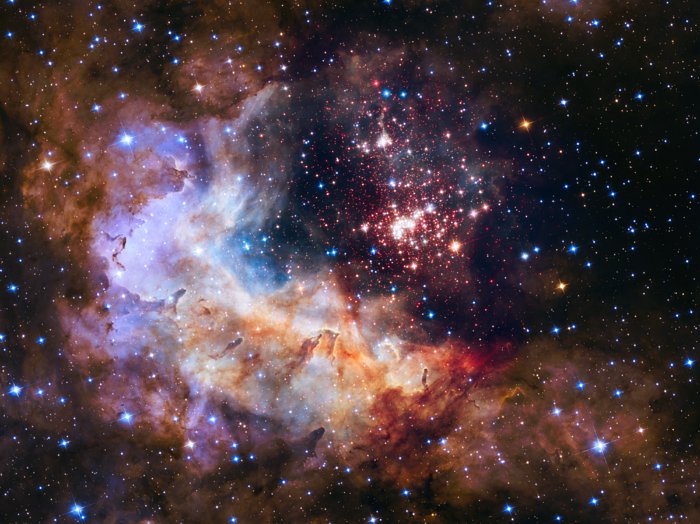
The Hubble Space Telescope celebrated its 35th year in space on April 24. As of that day, it had circled the Earth 191,756 times in its 95 minute orbit. It was put in orbit in 1990.
Also, May 30, 2025, was the 5 year anniversary of the first manned Dragon flight, DM-2, to the ISS. SpaceX has launched the crew Dragon a total of18 times, 11 times for NASA and 7 for private missions with a total of 68 crew. News about Starliner, the other Commercial Crew vehicle, is sketchy. Rumors are that NASA might make Boeing launch it uncrewed again in 2026. Thank goodness that NASA, in its wisdom, went with 2 vendors for the Commercial Crew program. With only 5 more years left in the life of ISS, I’m not sure NASA really wants to fly Starliner. Boeing’s price to send astronauts to the ISS is twice what SpaceX is charging for crew Dragon. $90 million per person is their price, that’s $360 million for a operational crew rotation flight.
For my little educational factoid, I asked the group if they knew what LRD’s are? There was an unanimous blank stare from the room. I went on to explain that LRD’s are Little Red Dots. They are the earliest galaxies discovered by the JWST and date back to 1.2 billion to .5 billion years after the Big Bang. 340 of them have been found so far. Astronomers think they are quasars and number 10 to 50% of all the early galaxies. Fraser Cain also weighs in on LRDs during the first 6 minutes of his video. There always has been a what came first, “the chicken or the egg”, question of whether super massive black holes formed from a direct collapse of matter or the accretion of smaller black holes. James Webb will help decide but it looks like direct collapse has the edge for being the right process. But astronomers still don’t know how such massive amounts of matter can merge without heating up and breaking into smaller parts. It must have something to do the the early conditions of the universe when there was only hydrogen and helium and a much denser environment.
NASA
Jared Issacman’s nomination to head NASA was withdrawn on May 31. This was after he was confirmed in the Senate Commerce Committee with a 19-9 vote and ready for a full Senate vote. The Administration blamed it on his contributions to Democratic candidates but that was information already public and he had contributed to candidates on both sides. He was going to be a good choice in that he was defending NASA’s science efforts and his 2 trips into space on Dragon made him very knowledgeable and experienced, but all the theatrics with Elon Musk and Trump probably nixed his chances.
In mid April, I watched Jared Issacman testifying before the Senators. It was a little awkward where he would not answer if Musk was in the room when Trump nominated him. He did say that NASA should push for a dual Moon-Mars effort and that science should be continued. Also, that the ISS should be kept in orbit to extract the most out of our $100 billion investment. This is contrary to Musk’s comments that the ISS should be de-orbited almost immediately. He wouldn’t say if he would close any NASA centers and he thinks we should fly at least Artemis 2 (manned loop around the moon like Apollo 8) and Artemis 3 (manned landing at the South Pole of the moon). I’m not sure when we should transition to a more cost effective commercial solution for moon exploration and get away from the overly expensive, $4 billion per launch, SLS. The group agrees it is a tough decision as to when to cut your losses. If we stop at Artemis 3, we don’t need SLS Block 1B with its expensive upper stage development, the second larger mobile launcher which is grossly over budget but effectively already built and Gateway in orbit around the moon, but again many of its modules are complete and already in Florida. According to the Planetary Society, SLS and Orion have cost us $49.9 billion from 2006 to 2022 when the first unmanned test Artemis 1 mission launched. It has probably cost a few billion dollars in each of the 3 years since then.
Secretary of Transportation, Sean Duffy named acting Administrator, taking over for Janet Petro who also was acting Administrator as well as the head of the Kennedy Space Center in Florida
Now for the most depressing news, the White House “skinny budget” for NASA. NASA funding is reduced by 25% from $25 billion to $18.8 billion. Science bears most of the cuts with an almost 50% cut. Planetary Science is cut by $2.2 billion and Earth science by $1.2 billion. Science cuts will cause 55 projects to terminate including ones planned and ones already in space. There will be no Venus missions, no Mars Sample Return (MSR), Artemis ends after the Artemis 3 moon landing and no Gateway in orbit around the moon. They can find $45 million for a parade in Washington but not provide the $30 million needed to keep the largest solar telescope, the Daniel K. Inouye Solar Telescope (DKIST), operating in Hawaii. It is a “bizarro world” with this White House.
According to Ars Technica the proposed budget, effectively ends SLS and Orion after Artemis 3 moon landing, Gateway is gone with its International support. The only hope is that it is a budget request and Congress can specify something else. SLS is costly with over $4 billion per launch and this stops the overprice second launcher and development of the new upper stage. Orion might have remaining value in that it could be launched on other rockets. MSR is cancelled and the plan is to have humans pick up the samples. Like that will happen anytime soon. Human space exploration got more money for Mars potential missions. The ISS crew size will be reduced. I feel the remaining moon program is just another flag planting and not the methodical moon exploration that I wanted to see. We are conceding the next return to the moon to China.
Casey Dreier of the Planetary Society has a link where you can contact your Congressmen and email them that you do not support these drastic cuts to NASA’s science programs. In the above site, click on “Contact Congress” if you agree with this. Please take the time to make your feelings known to Congress. It might be our only chance to prevent this generational brain drain on US science and NASA’s stellar reputation. It only takes a few minutes. The site will ask your address, name, zip-code and email address. The Planetary Society is very good in respecting your information, so don’t let that concern stop you from acting. The Planetary Society shows that this is the largest single year cut to NASA in history. The science budget is cut by 47%, MSR, Nancy Grace Roman telescope which was to replace the Hubble and Vera Rubin Telescope budget will all be reduced. In contrast, the “Golden Dome” military space program is advancing with a $542 billion price tag over the next 20 years and $25 billion this year. Something is really wrong with our priorities.
As this “bizarro world” continues, the “Big Beautiful Bill” has a section where Senator Ted Cruz of Texas is giving NASA an extra $10 billion but it is all for SLS and Orion and a communications satellite around Mars, nothing for NASA science. It even includes a ridiculous $85 million to move the Space Shuttle from the Smithsonian in Washington to Houston. $80 million of it is for a new building in Texas and only $5 million for the move. It funds Artemis 4 and 5 and Gateway. It continues ISS staffing and the deorbit of the ISS but nothing to restore the cancelled science missions. Those extra Artemis missions means SLS Block 1B with its new upper stage and the taller mobile launch platform will be created. This bill has been signed by Trump and now is law.
Again the White House NASA budget is a proposal. Recently there was a bi-partisan effort in the Senate to restore the NASA science budget. The day of the meeting, a story broke that the Senate appropriations committee voted in favor of a bill rejecting Trump’s NASA budget cuts, but discussions are still ongoing. The bill would give NASA science $7.3 billion this coming year and counter the slashing of that part of the budget by 47% by the White House. The bipartisan bill won by 15-14 but contention surrounding the location of FBI headquarters caused it to be withdrawn. Those politicians would argue about how many angels fit on the head of a pin. The proposed bill funds NASA at $24.9 billion, slightly about 2025 level. It would avoid the deep cuts that would terminate 55 operating and planned missions. It also continues SLS and Orion until a commercial replacement is ready. Finally it supports NSF and fully funds the National Weather service. Although this is a little bit of optimism, remember that any bill would also have to pass the House and get a signature from the President.
Mars or the Moon
It seems the current administration is going to a more Mars based effort and making Artemis another lunar “flag planting” excursion. I don’t think we are anywhere near ready to go to Mars with people and gutting the science budget won’t get us there any time soon.
Artemis 2 is scheduled in less than a year. There current plan has it launching in April 2026. That mission will be the loop around the moon by 4 Orion capsule astronauts similar to the Apollo 8 mission in 1968. The current White House request seems to be concentrating on Mars rather than the moon. I thought we were doing the moon to learn how to live on another celestial body and develop our technology to support farther trips like Mars. The moon is only seconds away in communication time and an emergency return could be only a few days. Neither of these criteria apply to a Mars mission. Is this all due to the early Elon Musk influence on Trump? Now that they have had a falling out, who knows if tomorrow’s focus will be the same. Our current space policy is like watching a reality TV show with all its plot twists and turns.
The “This Week in Space” podcast is one of my favorites. It features Rod Pyle, editor of the National Space Society magazine, Ad Astra, and Tariq Malik, editor-in-chief of Space.Com. In their 3/21/25 episode, they featured an interview with Robert Zubrin. Sometimes Zubrin is a little hard to swallow with his “my way” or the “highway” attitude, but I thought he had some thoughtful ideas about Mars exploration and how the current NASA culture compares to the Apollo efforts in the 1960s. The best part of the interview is from 28:00 to the end. He talks about how Apollo was a goal driven program compared to Artemis which is vendor driven. That is why Apollo got us to the moon in 8 years but Artemis has launched only once in 20 years and spent $100 billion. NASA’s Manned Space Flight Directorship is vendor driven with 5 major parts of Artemis, SLS, Orion, Starship, the Blue Origin moon lander and Gateway. But the Science Directorship is goal driven. The Mars Spirit and Opportunity rovers weren’t driven by the air-bag lobby. He goes to explain why now is a good time for a Mars mission The subject came up in Trump’s inauguration speech with his line about how it is the US’s “manifest destiny” to go to Mars. This part of Zubin’s comments are a little dated when he comments how Musk has Trump’s ear. But he goes on to say that this plan is fraught with peril because Trump and Musk are too polarizing. Apollo was a national goal. Don’t give NASA over to SpaceX. The Mars effort has to be broader than Musk’s idea of “white flight”. And don’t go out of despair, but go for the hope of humanity. Starship on Mars has to be a science mission not a Tesla robot mission. If the plan has bipartisan support, includes the free world and includes a concentration on science, the Democrats would support it. The 50% cuts to the NASA science budget won’t enable the Mars effort. It is an insult to humanity. We’ve got to cooperate with free world and maybe be in competition with China for it to be successful. Starship has a weakness with landing and then taking off. What is needed is a small StarBoat spacecraft that can go down in gravity wells. Convert Blue Origin HLS lander (Mark 2) to StarBoat development and make it methane fueled not hydrogen. Musk and NASA science cuts are a real threat. Cancelation of the lunar VIPER rover and Venus missions are just the start. Use the Planetary Society action site to get our representatives on board and tell them we want a StarBoat. Here is a good summary of StarBoat.
At the meeting we didn’t get a chance to discuss Zubin’s full Atlantis article , but here it is if you are interested. This article discusses how we have a once in a generation opportunity for embark on a Mars program but NASA should lead the effort not SpaceX. First, we have to fix NASA. It has a bunch of incompatible Artemis parts, the SLS 2nd stage is too weak, Orion is too heavy, Starship makes SLS and Orion unnecessary. But Starship is too big for its moon mission. The Blue Moon lander (also referred to as Mark 2) from Blue Origin uses incompatible hydrogen/oxygen. NASA is prioritizing vendor satisfaction over their needs. The Gateway, near-rectilinear orbit, makes Starship require 14 refuelings when an equatorial site on the moon would only need 10. Artemis is not a purpose-driven but vendor-driven program. Going with SpaceX would kill the system once the Democrats resume power. Mars program must have broad support. It needs to be the government’s program rooted in science to garner the world’s admiration for the United States. The mission must be first and the Artemis jobs program eliminated. The 3 reasons to go to Mars are: 1) the science; 2) the challenge and 3) the future. We must find out if Mars has or had life. Having people there is the only way to dig deep into the search capabilities. The challenge would be a boon to our economy, the way to world leadership, a new generation of science and engineering jobs and motivation for our youth. Only nations that have a hand in Mars exploration will be able to put their stamp of morals of the new Martian society. Mars has all the resources needed, carbon, water, nitrogen, 24 hour day, thin atmosphere that provides 2 foot of water equivalent of radiation shielding. Don’t go to Mars because civilization on Earth is going to collapse, it is not moral to abandon the earth, we are going to Mars to open a new frontier. We don’t go to Mars to plant a flag but to explore the science. Accept the challenge and build for the future. Best vehicle is Starship with 2 orders of magnitude cheaper and 20 times the launch rate of other rockets. With 6 refuelings it can transport 100 mt cargo and 600 mt of prop to Mars, land on Mars and stay for 1.5 years. Use in-situ refueling and fly back to earth with a crew of 20 and 10 mt cargo. If we used Starboat, we’d only need 120 mt of prop. Its mass is a fifth of Starship. With a crew of 4-5, it could launch on Falcon 9, Neutron or New Glenn rockets. Drop MSR. First launch a robotic starship mission by 2028 and then in 2031 send first manned mission Mars.
Just some thoughts from me. Progress today does seem to be slower than in the past. From President Kennedy’s speech to Congress on May 25, 1961 where he announced our goal to land men on the moon to the Apollo 11 landing on July 20, 1969, it was only a couple of months longer than 8 years. In contrast, Musk’s announcement of his big new rocket, the ITS (Interplanetary Transport System), at IAC on September 27, 2017 until now is already just a couple of months short of 8 years. But so far, Starship and the Super Heavy Booster have launched 9 times but not achieved orbit. Kennedy’s announcement of the moon effort seems even more audacious when you consider that the Alan Shepard sub-orbital flight was on May 5, 1961 only 20 days earlier. John Glenn’s first orbital flight didn’t occur until almost a year later on February 20, 1962.
Blue Origin updates plans for its transporter for Blue Moon Lander – Unfortunately, SpaceNews has now put their articles behind a “pay wall”. So you can see a picture of the transporter but you would have to pay to read the full article. Here is what it said before the pay program started. The transporter will be used for the Mark 2 manned lunar lander. It is part of the $3.4 billion award from NASA for its second HLS lander. The transporter will aggregate liquid hydrogen and oxygen propellant in Earth orbit and then take it to the near-rectilinear halo orbit around the moon where it will transfer it to the Blue Moon (Mark 2) lander. It will launch on a New Glenn rocket. The number of refueling launches was not disclosed. A key enabler for the system is zero-boiloff technology to prevent cryogenic propellants from leaking into space. Liquid hydrogen needs to maintain 20 degrees Kelvin above absolute zero (-424 in Fahrenheit) and liquid oxygen needs 90 degrees Kelvin. A fully fueled transporter can carry 100 mt to lunar orbit and 30 mt to Mars orbit. Both an uncrewed test and crewed landing are planned before the end of the decade. The smaller Mark 1 (3 mt on moon) is expected to attempt a moon landing on the South Pole in 2025.
GreatSpaceX video where NASA said that Blue Origin is scheduled as the next lunar landing in August 2025 surprising everyone that their Mark 1 HLS lander is ready that early to go on a New Glenn rocket. It will be largest spacecraft to land on moon. Additional CLPS missions include, another attempt by Intuitive Machines with IM3 in 2026 and Firefly’s second mission in mid-2026 and then Draper in the 4th quarter of 2026. The Mark 1 about the size of LEM but is capable of putting cargo 3mt of cargo to the moon’s surface. The larger Mark 2 will be able to put 30 mt on the surface in expendable cargo mode and also 20 mt in a crewed reusable mode. The Mark 2 will need refueling missions and a transport tug to take it to the moon.
Another of my favorite podcasters is astrophysicist and science educator, Paul Sutter. He recently weighed in on Musk’s Mars plans and the seesaw politics of the US. In the Paul Sutter video he tells us we are not going to be occupying Mars in 2026 or 2028. He also weighs in on the whipsaw politics of going to the moon and then not.
Astronomy
For one of our more upbeat topics, we had first light pictures from the Vera Rubin Observatory in Chile. The telescope’s 10 year survey program will cover the entire southern sky (70% of the sky up to 10-15 degrees north of the ecliptic) every 3 days. This will effectively build a movie of the sky catching anything that moves or varies in brightness. There is a call to build one of these telescopes in the northern hemisphere but the best place is Hawaii and that place has issues with the indigenous people. It would probably have to be built in the Canary Islands which doesn’t have quite as clear skies.
In just 10 hours of test observations, the 8.4 meter (331 inch) Vera Rubin telescope in Chile captured millions of galaxies and thousands of new asteroids. Download one of the larger picture formats and zoom in on the detail, it is amazing. This Fall it will begin its 10 year program photographing the entire southern sky. Pictures will be placed on the Internet for download by astronomers and amateurs alike. I challenged the MASS group to come up with a study where we can all author our first scientific paper using data from Vera Rubin. The first picture shows galaxies in amazing detail. The telescope hopes to record 20 billion galaxies over it’s 10 year program using its 3200 megapixel camera which is the size of a car. It has taken over 20 years to construct the facility and it was primarily funded by the NSF. Hopefully, there will be enough budget to operate it. The second video shows the 2100 new asteroids discovered. There are currently a million known asteroids and Vera Rubin will discover another 5 million of them. Finally there is a picture of the Trifid nebula. You would need a TV the size of a tennis court to see the full detail of the image at one time.
Fraser Cain does a nice job explaining the pictures and how the observatory will operate.
SpaceX
Last meeting we talked about the IFT8 launch of Starship which occurred on March 6. The mission included a third booster catch but the StarShip second stage exploded as it was approaching the end of its sub-orbital burn. Then IFT9 occurred on May 27 with the first reuse of a booster. There was not going to be a catch attempt and Starship again had issues when it lost attitude control and exploded. During this flight there was no test deployment of Starlinks satellite simulators, no re-light of a Raptor engine to demonstrated controlled de-orbit of Starship and no controlled re-entry. It doesn’t seem like SpaceX pushed development of Starship very much on this flight.
On 6/18/25 Starship 36 exploded during the fueling prior to a 6 engine static fire. Looks like a June 2025 IFT10 launch won’t be happening for quite a while. Version 2 of Starship seems like it is subject to several catastrophic flaws.
Damage to the test facility will delay progress on the next launch. The latest explosion comes on the last 2 missions having Starship explode in space and not complete its mission. We might have to start rooting for Blue Origin to get their moon lander programs going. They plan to land a smaller “cargo only” lander this year on the moon using their New Glenn rocket.
In a rare shortening of the MASS meeting, we adjourned at 9:30 so people had the best chance of getting home before severe weather moved in. I wished everyone safe travels.



Recent Comments