MASS Meeting August 7, 2026
What a great meeting for our 15th anniversary! We set an in-person attendance record of 12 with Dean, Laura, Keith, Hank, Dave, Phil, Harry, Don, Beth, Chad (late arriver), Carol and myself.
This was our 93rd meeting. Our first one was on July 21, 2011 and its main topic was “Commercial Crew”. It’s funny that certain topics manage to stay in the news for so many years. It is also ironic that our first meeting date only missed the Apollo 11 moon landing date by 1 calendar day (July 20, 1969 – 57 years ago) and the Viking 1 landing date on Mars (July 20, 1976 – 50 years ago).
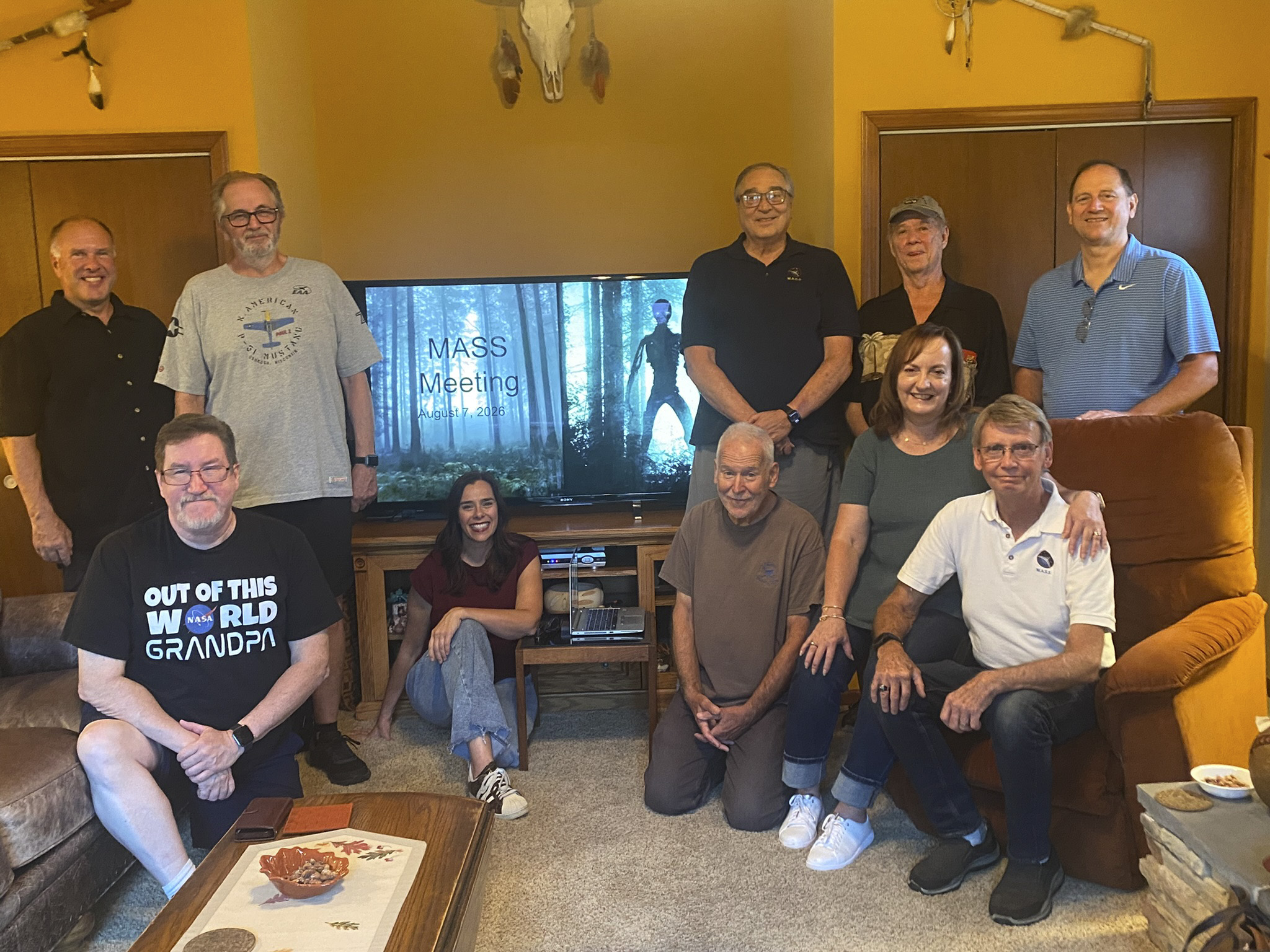


We waxed a little philosophically about how the group was formed 15 years ago and continually added to ever since. Dean was giving lectures at the Villa Park library and we thought why depend on the library to meet up and discuss recent events, so we formed the MASS group. We enlisted frequent attendees of Dean’s lectures at the library as well as ones that came to the monthly Triton astronomers’ presentations in River Grove. Dean, Dave, Phil and I were all at the first meeting, along with Silvio and Judy Grove. Harry was an attendee at our second meeting. Later, thru NSSS meetings at the Schaumburg library, I met Keith (first meeting #27) and Hank (first meeting #64). Beth also gave a presentation at the Villa Park library and she and Chad first attended MASS on meeting #53. Don and I were introduced to each other by the staff of our local health club in Elmhurst. It pays to wear space/astronomy related shirts. Don’s first meeting was #81.
First topic of the night was my granddaughter, Emily’s, encounter with a train of Starlink satellites the day after our last meeting, Saturday May 2. Her friends thought they might be aliens, so she called me. I reassured her that they were not aliens but a common occurrence of recently launched SpaceX Starlink satellites. SpaceX had launched 29 of them from Florida on the previous afternoon of May 1. The Starlink app on my phone said they were magnitude 1.3 on the night of her sighting, which is quite bright. I tried to spot them Sunday night, but they had already dimmed to magnitude 2.8 and I couldn’t see them in our light polluted skies. So far, SpaceX has launched over 12,600 Starlink satellites and if you get a chance to see a recently launched batch of them go across the sky, it is quite a sight.

SpaceX IFT13 Flight of Starship
We then moved on to the recent IFT13 SpaceX Starship launch which occurred on July 24. The first flight of version 3 of Starship, IFT12, also occurred since our last meeting. But that is old news now. The IFT13 launch was only 2 weeks ago and it went better than IFT12 but not perfect. The first stage booster failed to light all the necessary engines for its Gulf landing burn and crashed into the water at a considerable speed. The upper Starship stage was more successful. All its engines lit to put it into a sub-orbital path, it then deployed 20 version 3 Starlink satellites, relit one of its engines to demonstrate that it can make a controlled re-entry from orbit and landed so softly in the Indian Ocean that it is still floating. SpaceX is attempting to tow it back the 600+ miles to Australia for further inspection. Most recent news says the recovery is not going well, rough seas and a strong current to the west is keeping the recovery attempt challenging. If it would over a month to tow it to Australia, SpaceX might have better information from the Starship they hope to catch on the chop-sticks in Texas after the IFT14 flight coming in early September.
We used Marcus House videos to show the amazing video of the mission. The second video has more slow-motion and also recovery attempts for Starship.
Elon Musk says they will go orbital for flight IFT14 and possibly even try to catch the Starship upper stage in the chop-sticks at the Texas launch pad after it circles the Earth. This new launch could occur before the end of August. If they launch a full load of 60 of their V3 Starlink satellites on Starship, that batch will have the bandwidth capacity equivalent to 23 Falcon 9 launches with 23 older Starlinks on each Falcon 9. That would definitely be exponential growth of launch capability. SpaceX is wiping out the competition for Internet from space.
Fermi Paradox – Dark Forest
We then pressed on to our main topic, the “Dark Forest” hypothesis which is one of the solutions to the Fermi Paradox. Keith used our newly created group text called MASStronauts to share the link and most of us have already watched the video. So I started with a good summary of the Fermi Paradox by astrophysicist, Brian Cox. We only watched the first 21 minutes of the video.

It all began with atomic bomb physicist, Enrico Fermi, asking his lunch-time companions, “where are all the aliens?” If life is teeming in the Milky Way, we should have seen them by now. Thus, the Fermi Paradox. It could be explained by: 1) advanced civilizations being rare. It takes a very unique planet like Earth with its right type of stable star, a large moon to maintain a stable planetary rotation and plate tectonics to remove an over-abundance of atmospheric gases like carbon dioxide. All these criterion make for the “Rare Earth” supposition; Or the paradox could be explained by, 2) the aliens are here but we just don’t recognize them, they could we using tiny nanobots that have escaped our detection; or 3) stars are too far apart for inter-stellar travel to occur; or 4) the “Dark Forest” hypothesis that alien civilizations have learned to keep quiet about their existence, so they don’t get annihilated by another more advanced civilization; or 6) civilizations don’t last for a long time, things like bad Artificial Intelligence, nuclear war, engineered global pandemics or they just get complacent and give up on the desire to explore. Any of these can be the Great Filter which quashes a civilization’s existence and makes it relatively short-lived.
Scientists feel that an advanced civilization would build self-replicating von Neumann probes that would hop from stat to star at 10% the speed and light. The exponential growth of these probes would colonize the entire Milky Way in just 10 million years. This amount of time is only a blink of the eye, to the 13.8 billion year old universe. Cox comes to the conclusion that there aren’t any other civilizations in the Milky Way. We are it. He feels that although single-cell life formed quickly on Earth, multi-celled thinking creatures took 4 billion years to form. That amount of time takes a very long-lived stable environment for it to happen.
One of my favorite, YouTube video creators, Fraser Cain, also weighed in on defining the Fermi Paradox. In the first 13 minutes of his video, Fraser makes the point that the universe is big (92 billion light-years in radius) and old (13.8 billion years). Stars are numerous. The best guess is that the Milky Way galaxy has 100 to 400 billion stars and there are 2 trillion galaxies in the visible universe. Those statistics would make the star count be 1 septillion (10^24, 1 followed by 24 zeroes). Probably there are more planets than stars. There are a lot of places where life can experiment and a lot of time for it to try different things with developing life.
And for your reference, here is the link to the “Dark Forest” video. It is a full 36 minute video. In a way, the hypothesis is positive, in that it assumes many advanced civilizations. But on the “dark” side, it posits that civilizations, no matter how gentle and nice they are, will come to the logical conclusion that a detected other civilization must be eliminated. The logic dictates that for your own civilization to continue to exist, you must wipe out this potential competing civilization. The distance between stars will never allow the two civilizations that detected each other, to communicate on a frequent enough basis to ever form “trust” in the other’s motivation.
I tried to get a summary of the group’s thoughts on what explanation they think is most likely to explain the Fermi Paradox. But alas, it was like herding cats. It could be dangerous to try to speak for the group but I did hear that only 3 of the 12 (Don, Hank and I) feel there is only 1 advanced civilization in the Milky Way. Most of the group takes the optimistic position that they are many. A large part of the group feels that we should stay quiet about our location. But they recognize that the cat might be out of the bag with our radio and TV signals going out into space. An alien civilization could also detect of oxygen and fluorocarbon gases in Earth’s atmosphere using spectroscopy. Once they detect those bio-markers, they would know life exists on Earth. We could never stop that type of detection. Several people feel it is mankind’s responsibility to explore and try to make contact with the aliens. But we were also reminded about the Twilight Zone episode titled, “To Serve Man”, that ended with a shout, as people were boarding the alien spacecraft, that “ITS A COOKBOOK!!
No one in the group thought the Earth could agree on who would speak for the entire planet on future signals sent out into space. That makes me wonder how “advanced” our civilization really is.
Large Telescopes
We then moved on to some telescope topics.
The Vera Rubin Telescope down in Chile went live on its 10 year movie of the southern sky on June 30. The $800 million observatory boasts a 8.4 meter(331 inch or 27.6 feet) telescope and the largest digital camera with 3200 megapixels. To give you an idea how much detain is in this camera, it would take 400 4K HD TVs arranged in a grid to display a single image. Every clear dark night the observatory will take 30 second exposures thru various filters and then move to another section. It return to the same part of the sky every 3-4 days, giving twice a week images on how the universe is changing. Over 10 years it should take 800 images of every point in the southern sky. It is expected to see 20 billion galaxies, 17 billion stars and 6 million new asteroids. We’ll see how it copes with the 15,000 satellites zooming around the Earth. Here is how the observatory looks. It has this odd shape so it can efficiently re-coat its mirror quickly to maintain its optimum light gathering ability.
Another big telescope in the news is the Roman Telescope. It is ready for a Falcon Heavy launch as early as August 30. The $4.3 billion (includes 5 years of science operations) Nancy Grace Roman Telescope promises 100,000 new exoplanets, billions of stars and galaxies and new information on the evolution of the universe. The project began 15 years ago when the 2010 Decadal Survey recommended building the WFIRST (Wide Field InfraRed Survey Telescope) telescope. In 2012, the NRO donated a 2.4 meter (95 inches or 8 feet) mirror to NASA, the same size as the Hubble Telescope. The fact that the National Reconnaissance Office had 2 spare Hubble telescope mirrors shows how much money we spend on Defense compared to Astronomy. Nancy Grace Roman was NASA’s first Chief of Astronomy and is commonly known as the “Mother of Hubble”. Last year the White House suggested cutting its funding in half. That shows we still have a lot of work ahead to try to get science funded in the United States at a reasonable level. Roman will have a field of view 100 times as large as Hubble, .28 square degree or 40% larger than the full Moon. During the 5 year planned life, it will survey the sky 1000 times faster than Hubble. Its quickness is due to the larger field-of-view and the fact that it will be at the L2 LaGrange point and not have to contend with the Earth blocking half its view. Only a quarter of its time will be for astronomers to request observing time, the rest will be for surveys. Most of the exoplanets will be discovered using the transit method but 2000 are expected from microlensing. First images are expected after a 3 month commissioning phase after it reaches the L2 Lagrange point. December is when first images are expected.
Little Red Dots (LRDs)
We didn’t get a chance to discuss this at the meeting but I can not skip a chance to talk about Little Red Dots (LRDs). They are the recently discovered objects in the early universe discovered by the James Webb Space Telescope (JWST).
Space Bites talked about GLIMPSE-17775 8:20 to 11 minute mark of video.
Sky & Telescope reports that one LRD is a supermassive black hole cocooned in gas so dense it’s opaque but glowing in the infrared. JWST has found many LRDs but they started to disappear 1.5 billion years after the Big Bang. Are the galaxies bursting with star formation or just dust enshrouded supermassive black holes? Webb took a 20 hour spectrum which was enhanced to 80 hours by gravitational lensing of LRD GLIMPSE-17775. It exists 1.8 billion years after the Big Bang. Spectral lines indicate that a dense cocoon of gas surrounds the central source. Observations are consistent with an actively feeding 5 million solar-mass black hole surrounded by layers of gas that absorbed the black hole ultraviolet and reemits it at the infrared. The LRD is also embedded in a substantial host galaxy which explains the Balmer break dip due to bluer light from the galaxy’s stars. But the black hole is guzzling gas at twice the rate known as the Eddington limit. The findings support the theory that supermassive black holes found at the center of large galaxies grew from “heavy seeds. Where these seeds came from is still debated. Massive seed formation needs to be very efficient in the early universe to create all the LRDs observed.
Just when I thought LRDs were being explained, someone proposes an alternative theory for what they are. This might not be the consensus of thought, but astronomers at UT- Austin think they are enormous stars that will eventually turn into globular clusters. They are estimated to be about 70 light-years in size.
NASA Topics
Another topic we didn’t get a chance to discuss.
Starliner
Boeing first unveiled the CST-100 to the public in 2010. It was part of NASA’s Commercial Crew program, which was formed following the retirement of the Space Shuttle in 2011. In September 2014, NASA awarded Boeing $4.2 billion to develop Starliner and $2.6 billion to SpaceX for the Crew Dragon. At the time, NASA thought Boeing was the better bet. Starliner’s Orbital Flight Test-1 (OFT-1) occurred in December 2019 and was an unmanned flight to the ISS. A software anomaly with a bad mission elapsed time clock, made the capsule waste its maneuvering fuel and not perform the docking. The OFT-2 mission was delayed by corroded values but finally launched in May 2022, docked to ISS and returned to Earth. Meanwhile, SpaceX successfully sent an uncrewed Dragon to the ISS on March 2, 2019 (DM-1) and a crewed one on May 30, 2020 (DM-2). There have been 12 NASA crew rotations (thru CREW12) missions and 7 private missions since with the Dragon capsule. Getting back to Starliner, parachute issues and flammable tape on wiring delayed the Crew Flight Test (CFT) from launching until June 5, 2024 with Butch Wilmore and Suni Williams. The capsule experienced several thruster failures and helium leaks during its approach to the ISS. NASA determined it was too risky for the astronauts to return on Starliner. On September 6, 2024, the empty Starliner undocked and returned to a safe landing in White Sands, New Mexico. Since then, NASA has determined that Boeing must fly Starliner as a cargo only mission to the ISS, after its thruster issues are resolved. NASA also reduced the number of crewed Starliner missions to the ISS to 4. The ISS will be retiring in 2030, so at most, only one Starliner mission is needed each year. SpaceX was funded for 6 more crew Dragon missions, thru CREW20. With SpaceX saying they might retire Crew Dragon, a new Commercial Space Station could have issues if Starliner doesn’t serve as a back-up capability. Starliner is at least twice as expensive as Crew Dragon. Boeing charges NASA $90 million each for its 4 seats on Starliner, SpaceX only charges about $45 for a seat on Dragon. Another issue for Starliner is that it will run out of its rocket, Atlas 5, after its 4 Boeing missions to the ISS. Certifying Vulcan or another rocket for manned flights won’t be cheap. Should we start rooting for a manned Dream Chaser from Sierra Space? A cargo version of Dream Chaser is still under development with a Vulcan launch to the ISS planned by the end of 2026.
Boeing feels they might fly their cargo mission to ISS in 2026 but the problem is that there are only 2 compatible ports on the ISS and one is always taken by a Dragon capsule supporting the current crew. Ars Technica reports on Starliner.
NASA Space Flight did a nice 4-minute summary of Starliner. Their video also leads into the LINK rescue of the Swift Observatory ( 3 minutes), and the crash into the moon of the Falcon 9 second stage at 1:34 AM on August 5.
LINK – a mission to save the Swift Observatory
The LINK spacecraft, a mission to save the Swift Observatory, launched aboard a Pegasus-XL rocket dropped from an L-1011 aircraft flying from Kwajalein Atoll in the Marshall Islands on July 3. Swift has been in space since 2004 studying gamma-ray bursts in visible, x-ray and gamma-ray bands. It’s orbit is decaying more rapidly due to increased solar activity. In just 9 months and $30 million, a project with company Katalyst was developed to save the observatory. LINK will have a commissioning period of a few weeks before approaching Swift. The observatory is not designed to be reboosted and doesn’t have grappling fixtures. Once joined, LINK will use its Hall thrusters to slowly raise the orbit over a period of 2 to 3 months. Time is of the essence. NASA estimates that Swift’s orbit will drop below 300 km in October, after which a reboost would not be possible. An update on July 29, said that LINK has lost 2 of its 3 reaction wheels and is spinning in space. In a more positive note on August 7, NASA said they were able to reduce the spin from 9 to 1.5 degrees per second. This might allow LINK to resume its ascent to the Swift Observatory orbit.
Rocket crashes into the moon
The upper stage of the Falcon9 rocket, that launched the Blue Ghost lunar lander in January 2025, will crash into the moon on August 5 near the western limb. This is near the craters of Einstein and Bell. Estimates are for the impact to create a 47 to over 60 miles central ejecta spike height. News after the impact said that apparently no one saw the impact visually. In 6 more days, the Lunar Reconnaissance Orbiter (LRO) will pass over the impact site and try to image the potential 60 foot wide and 12 foot deep crater made by the rocket traveling at 5400 mph and weighing 9000 lbs.
Did you know that the FCC gave a company the ok to put mirrors in space
The FCC approved a company called Reflect Orbital to put mirrors in space. The company says it aims to place 50,000 mirrors in orbit by 2035 allowing for “full noon” brightness in spots. These mirrors will increase agricultural productivity, aid disaster relief efforts and allow solar panels to make electricity at night. The FCC gave them approval to launch Earendil-1 later this year into a 625 km orbit. The mini fridge sized spacecraft will deploy a mirror the size of a tennis court. This test mirror will illuminate a patch of roughly 24 square kilometers. With Elon Musk also wanting to put a million “Starmind” satellites in orbit to support his AI data centers in space, we seem to be headed for dystopia.
Moon Base Update
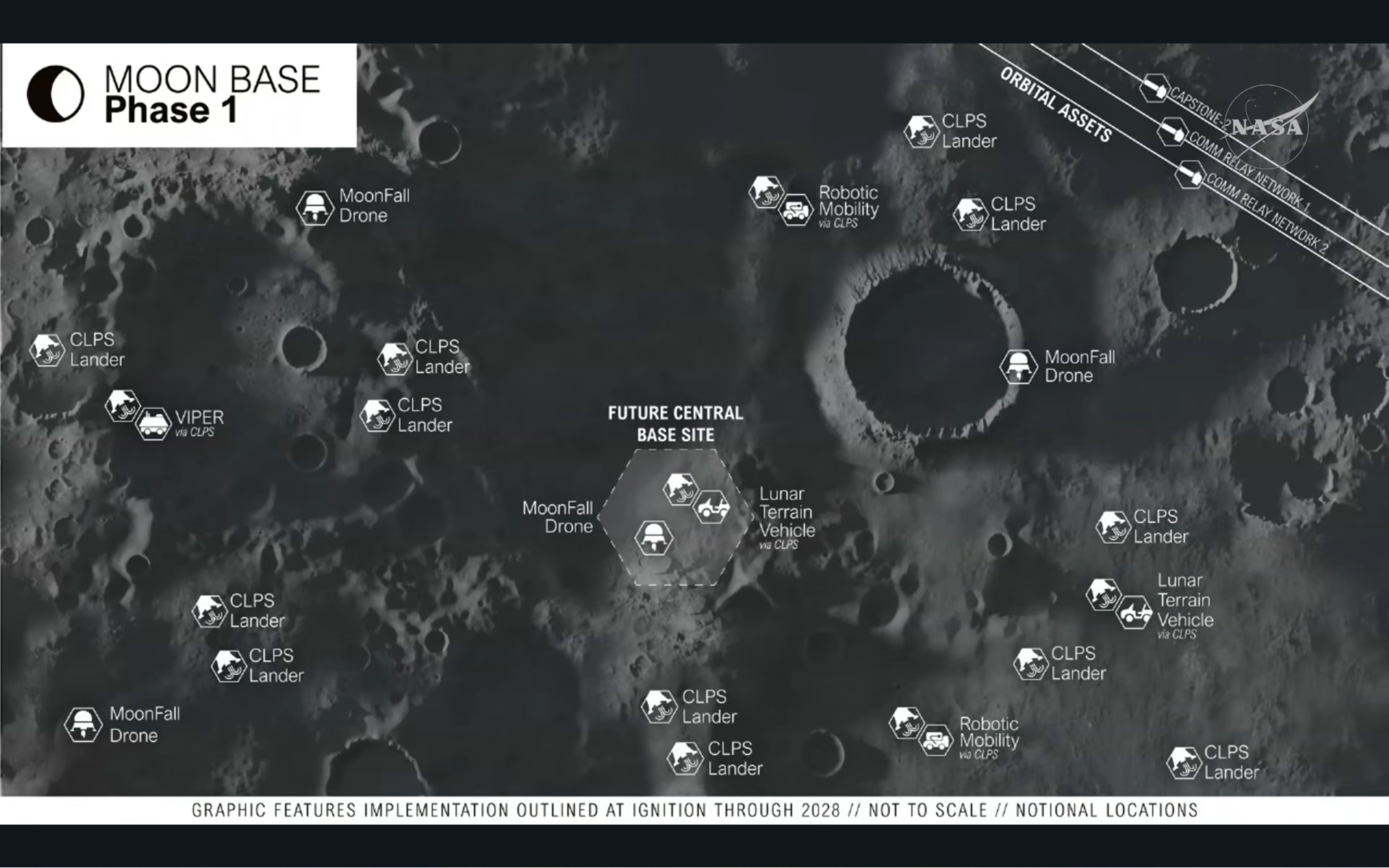
NASA Administrator, Jared Issacman, said he will give us monthly updates to Artemis and the moon base planning. The most recent update concerning the moonbase was reported by Space.com. The base will be developed in 3 phases: phase 1 (now until 2029) includes 25 launches and 21 landings with 4mt of payload landed; phase 2 lasts from 2029 to 2034; and phase 3 begins 2034 and goes on from there. There is a new naming scheme for what used to be the Commercial Lunar Payload System (CLPS) missions, MB-1 (Moon Base 1) is the MK1 Blue Moon from Blue Origin landing on the Shackleton ridge in fall of 2026, MB-2 is Astrobotic Griffin lander with the FLIP rover in 2026 and MB-3 is Intuitive Machines Nova-C lander landing near the Reimer Gamma swirl also in 2026. FLIP is the rover that is carrying Beth’s “Stories of Space” device. Carlos Garcia Galan is the new Moon Base lead and Nujoud Merancy is its chief architect. New lunar delivery awards for LTVs (Lunar Terrain Vehicles) went to Astrolab for its FLEX vehicle ($219 million) and Lunar Outpost for the Pegasus vehicle ($220 million). Blue Origin will get $234 million for delivering each of the 1 mt LTVs to the lunar surface with its MK1 lander. Both of the LTVs support a crew of 2 astronauts. MoonFall is the name of the drone spacecraft that can survive the night and establish the perimeter of the 100s of square mile hexagon moon base. Firefly will deliver 4 drones with one landing. In the future CLPS 2.0 mission will have a 2.5 mt landed payload capability.
Mars rover engineering model being repurposed to the moon
NASA is considering sending a Mars type rover to the moon. The full-scale engineering model of the Perseverance rover at JPL is a car-sized nuclear powered rover nicknamed “Promise”. Carlos Garcia-Galan and Jared Issacman are thinking hard on how to modify the Mars rover design to be moon compatible. It might take a heavy lander like the MK1 from Blue Origin to get Promise safely on the moon. There is still hope for the MK1 lander from Blue Origin to go to the moon this year, but a launch on New Glenn, that recently exploded during a static fire, is more likely in mid-2027. Phase 1 of the moonbase program is to: 1) get things to the moon reliably; 2) establish ground truth of what the south pole region is like and 3) build prototypes of what may become permanent infrastructure elements.
The US moon program seems to have a dilemma, is our goal to beat the Chinese back to the moon with people or are we trying to build on the Apollo legacy with much more capable missions. Should we be going to the lunar south pole first? The Blue Origin explosion shifted which Human Landing System (HLS) lander I thought would be ready first. Blue Origin had the lead, now I think SpaceX will get Starship ready first. Artemis 3, where the 2 HLS landers should dock with the Orion capsule in earth orbit, should indicate who has the lead in 2027. Phil made the comment at the meeting that it seems NASA is over concentrating on the moon program and short changing the rest of NASA science, like planetary missions. We’ll have to look at the budget to see where the money is being spent.
“The best HLS is the one that can beat China to the moon.” I’m not sure I agree with that statement but that is the opinion of Jim Bridenstine, former NASA Administrator. He thinks neither SpaceX or Blue Origin have a simple enough lander to do the job by 2030. Jared Issacman is more upbeat, he thinks one or both will be ready by 2028. He adds that the US plans to return in a different manner with a moon base in mind. Bridenstine is correct that the Apollo approach was more simple in concept and execution. One launch of the Saturn 5 did the job. Artemis is very complex. SpaceX HLS will need at least 15 Starship launches to get to the moon, one for a fuel depot, 13 to send fuel tankers to top off the depot and one for the HLS lander. The plan is now for Starship to take Orion to the moon. The Blue Moon MK2 lander will be less complex. It will need 3 New Glenn launches, one for the lander and 2 transfer stages. For both HLS landers these companies need daily launch cadence. Starship is the largest human rated object ever launched into space. Blue Origin recently lost its launch pad with the New Glenn static fire explosion.. Their goal is return to launch by the end of 2026. The problem is NASA has 2 tasks, beat the Chinese and start a lunar base. What does the group think, is beating the Chinese more important or going back with a more robust goal of a moon base? I didn’t get a chance to ask the group, but I’ll definitely do it on a future meeting.
Artemis 3 crew announced
NASA made the Artemis 3 crew announcement. It will be four guys this time. Dr Becky weighs in on the odds of NASA selecting an all male crew. She says selecting 4 males had a 14.4% chance, selecting 3 males & 1 female was 37.8% likely, 2 males & 2 females 33.8%, 1 male & 3 females 12.4%, and finally a crew of 4 females had a 1.6% chance. This is based on the current astronaut list of NASA and ESA. The crew consists of Randy Bresnik commander, Luca Parmitano pilot, Frank Rubio mission specialist and rookie Andre Douglas. For Artemis 3, Blue Origin is to launch their Blue Moon lander first, then SLS will launch and Orion will dock for a couple of days with it. The MK2 spacecraft can loiter in orbit for up to 90 days. Then finally Starship will launch for a docking, but the astronauts will not enter Starship. Total mission length should be about 2 weeks. The MKx craft for Artemis 3 will not have the BE engine or cryogenic fuels. Blue Origin says they will be ready to launch MK1 to the moon on New Glenn in 2026. Artemis 3 will not launch if Blue Origin is not ready, no matter what the Starship status might be. The Blue Origin craft will be a combination of MK1 and MK2 versions. The mission is planned for late 2027.
Beth weighed in on the potential crew for the Artemis 4 mission, the first US manned landing since Apollo. She feels the crew of 4 will consist of Anne McClain, Jonny Kim, Mathew Dominick, and one more person. I first thought her suggestion on guessing who will be on the crew sounds like a great new MASS Prize contest. But later consideration makes me think that just guessing the date of the Artemis 4 landing on the moon would be more straightforward and I’ll propose that to the group for feedback at a future meeting.
The SLS rocket is in trouble after Artemis 5. Artemis 3 will be an earth orbit mission in 2027 that intends to dock with both the Starship and Blue Moon landers but astronauts will be only able to enter Blue Moon and test space suits. Artemis 4 and 5 are lunar landings in 2028. But NASA is trying to commercialize SLS after that. The first moon landing of Artemis 4 will use the last Interim Cryogenic Propulsion System (ICPS) second stage. NASA has cancelled the Exploration Upper Stage (EUS) which would have been its replacement. Instead now NASA plans to use the Centaur 5 from the Vulcan rocket for the upper stage of SLS starting with Artemis 5. But there is no contract to build the Artemis 5 SLS core stage. Right now, SLS is only funded thru 2030. The Second mobile platform, SLS adapter for the second stage and the HALO module, have all been cancelled. That blew about $5.9 billion in spent money. If you feel bad about wasting that money, all those projects were still going to be even more expensive and late on delivery.
Blue Origin rocket explodes during a static fire
New Glenn rocket explodes during a static fire. Definitely the biggest explosion ever at Cape Canaveral and maybe the largest since the N1 rocket; New Glenn had just been cleared after its second stage failed to put a satellite into orbit. It was to carry a bunch of Amazon LEO satellites, which are safe, and then the first MK1 lander to the moon this fall. Pad 36A could be a complete loss, delaying the next launch for over a year. The BE-7 engines used on New Glenn also power the Vulcan rocket that is trying to make a comeback from a solid rocket booster anomaly. New Glenn had launched 3 times and was considered the front runner in boosting an HLS lander to the moon, Blue Origin’s MK-1. New Glenn’s first launch on Jan 16, 2025 made it to orbit but didn’t land the booster. On its second launch, on November 13, 2025, it sent the Escapade probe for a trip to Mars and landed the first stage booster on the recovery ship. On its third launch, Blue Origin reused the booster on April 19, 2026, but the cargo of several Bluebird satellites didn’t make it into orbit.
SpaceX
SpaceX set for its IPO in June. Things went well initially and many SpaceX employees became millionaires. Since then, Musk lost $600 billion recently so he is not a trillionaire. After peaking at a value of $1.33 trillion, his current worth is estimated to be $783 billion. SpaceX in their its first filing said it lost $541 million for the 3 months thru June 2026 due to AI investment, but that was less than what was expected. SpaceX stock has fallen to half of what it was at the IPO, Starlink revenue has jumped to $7.8 billion up more than 90% from last year, subscribers have also increased to 12 million. It will be the biggest IPO (ticker symbol SPCX) ever, even beating the $29.4 billion Saudi oil giant Aramco in late 2019. They are selling 555.6 million shares at $135 per share, it would value SpaceX at $1.77 trillion. But Musk rolled AI into the mix making SpaceX a loser in 2025. Musk argues the AI sector offers $26.5 trillion valuation. For context the entire US gross domestic product is around $32 trillion annually. The sale will make Musk the first trillionaire. It will bring in $75 billion to SpaceX. Musk will still maintain control of 80% of the voting shares of the company. SpaceX earned $4.7 billion in sales but had a net loss of $4.3 billion due to the AI segment. The IPO occurred on June 13 and the price was raised to $150 per share, it ended the day at $160. SpaceX with all the other companies rolled into it, isn’t really a space launch company anymore Starlink ($4.4 billion profit) turned it into a communication company and now with the additon of the Artificial Intelligence component, an AI company. SpaceX’s AI is xAI ($6.4 billion loss) and uses the Grok chatbot. We’ll see how having to answer to investors will change its space goals. SpaceX is valued at $1.75 trillion, which is above Tesla’s $1.57 trillion.
Dave said he bought some SpaceX stock to give himself an edge on future opportunities to go into space. He is willing to put his plumbing expertise to work for that important facet of living on other worlds. My Edward Jones advisor said he would not recommend SpaceX as a purchase because of its volatility. So far I’ve stayed on the sidelines watching the peaks and valleys of the stock.


Recent Comments